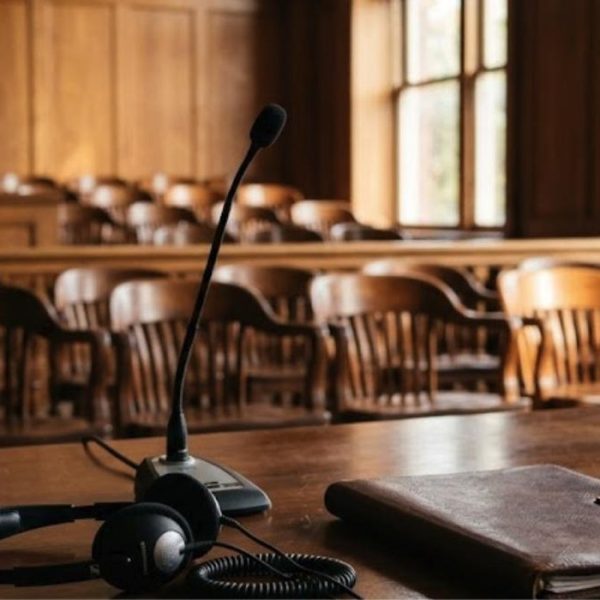
Anyone who has spent a morning in a New York courtroom has seen the moment. A witness leans toward a small microphone, hears her own language arriving half a second behind the question, and the room goes quiet while she answers. The person producing that voice is a court interpreter, and what she renders in the next ninety seconds can decide whether a case survives appeal.
It is skilled work that most people, including plenty of attorneys, assume is simpler than it is. The interpreter is not summarising. She is not smoothing out a rambling answer or helping a nervous witness sound more credible. She is reproducing register, hesitation and hedging in real time, under oath, while a judge, two lawyers and a stenographer wait.
What a Court Interpreter Is Actually Doing
The professional standard is conservation of meaning and form. If a witness says I guess maybe around ten, the court interpreter does not deliver approximately ten o'clock. The hedging is evidence. Jurors weigh confidence. Appellate judges read transcripts. Tidying up testimony is not helpfulness, it is an alteration of the record.
That discipline extends to profanity, slang, false starts and answers that make no sense. If a witness contradicts himself, the contradiction goes in exactly as spoken. The interpreter's only permitted intervention is to address the court directly, in the third person, to request a repetition or to flag an ambiguity that cannot be resolved without one.
Certification Is Not a Formality
Being bilingual and being a certified court interpreter are different qualifications, and the gap between them is wide. Certification exams test simultaneous interpreting at conversational speed, consecutive interpreting of long segments with note taking, and sight translation of documents handed over without warning. Pass rates are famously low. The federal court interpreter program publishes its standards in detail, and New York State runs its own testing and registry alongside it.
Hiring an uncertified relative or a bilingual member of staff to help out remains the most common and most expensive shortcut in this field. It manufactures appealable error, and opposing counsel knows exactly where to look for it.
The Modes, and Why They Are Not Interchangeable
Three modes do most of the work. Simultaneous interpreting runs alongside the speaker and is used when a defendant needs to follow proceedings that are not addressed to him. Consecutive interpreting alternates with the speaker and is used for testimony, because it produces a cleaner record. Sight translation covers documents read aloud into evidence. The differences between simultaneous and consecutive interpreting are not matters of style, they are procedural choices with consequences for the transcript.
Cognitive load is the reason team interpreting exists. Simultaneous work degrades measurably after roughly half an hour, which is why long hearings are staffed in pairs. Courts that refuse a second interpreter to save money frequently pay for it later in a rehearing.
Where Interpreting and Translation Part Ways
Interpreting is spoken and immediate. Translation is written and revisable. The same case often needs both, and the paperwork side carries its own rules. Foreign birth certificates, marriage records and academic documents entering a New York proceeding generally require certified translation, and when those documents will also be used abroad they may need legalisation, which is where apostille translation services enter the picture. Separate workstreams, separate deadlines, and conflating the two is how a filing misses its window.
Courtroom interpreters work under a standard most professions never face: the spoken record becomes the written record, and the written record becomes the ruling. Everything in that chain depends on somebody capturing speech accurately the first time, under pressure, with no opportunity for a second pass. The same logic governs medical transcription, where a clinician dictating at speed is trusting the transcriber to hear what was actually said.
Remote or In the Room
Video and telephone interpreting has become ordinary for arraignments, short conferences and rare language pairs where no local interpreter exists. It works well when the audio is clean and the exchange is short. PoliLingua's rundown of phone interpreter services is a fair account of where the format earns its keep.
For contested testimony, most experienced litigators still want on-site interpretation. An interpreter in the room sees the gesture that accompanies an answer, catches the mumbled aside, and can signal the bench without cutting across a video feed. When credibility is the issue, presence matters.
What Counsel Can Do to Help
Small preparations change outcomes. Send the interpreter names, technical vocabulary and any exhibit that will be read aloud, ideally a day ahead. Say which regional variety of the language the witness speaks, because Dominican and Peninsular Spanish diverge in ways that matter under cross examination. Instruct your client to speak to the attorney rather than to the interpreter, and to pause at natural breaks. Then slow down yourself. Lawyers, not witnesses, are usually the ones speaking too fast.
Why New York Raises the Stakes
More than two hundred languages are spoken across the five boroughs, and the courts hear a fair share of them every week. That volume produces genuine depth in Spanish, Mandarin, Russian and Haitian Creole, and real scarcity in languages where the qualified pool is a handful of people nationally. Booking early is not administrative fussiness in those cases. It is the difference between a hearing that proceeds and one that is adjourned.
The thread running through all of this is that a court interpreter is an officer of the proceeding rather than an accessory to it. Treated that way, given preparation time and workable conditions, the language barrier stops being the thing everyone in the room is quietly worried about.